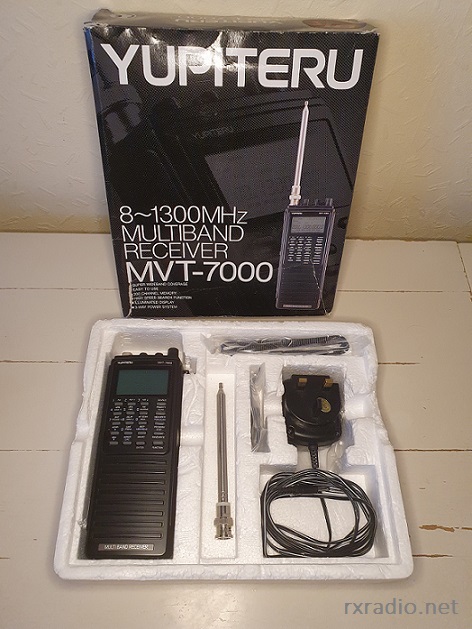
Back in the 1990’s there weren’t many scanner radios that were better than the Yupiteru MVT-7000. Even today, the MVT-7000 can hold its own against many of the much newer handheld receivers. The 7000 was however largely overshadowed by what is considered by many to be one of the best handheld scanners of all time. That is, the Yupiteru MVT-7100. This became “the one” to have, and many people understandably skipped the MVT-7000 because the 7100 could do everything it could do and more. A wider frequency range, more modes, better in lower high frequency [HF] bands, more KHz steps, and a light up keypad. Although the light doesn’t stay on for long unless the radio is modified.
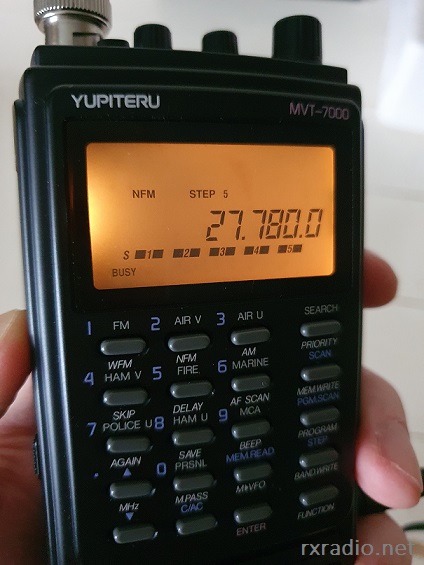
Quick specification for the Yupiteru MVT-7000. Frequency range is 8MHz – 1300MHz. The radio can go lower than 8MHz, all the way to zero in fact, but lower than 8MHz is not guaranteed. I have searched lower than 8MHz many times and picked signals up no problem. However, the lowest KHz step size on this radio is 5KHz, so not ideal for HF. It only has FM [narrow / wide] and AM and takes 4 AA batteries. Keypad does not light up, but the screen does.
Light Options
There is a “lamp” button on the side to activate this feature. But the screen light only stays on for as long as the button is pressed. Once the button is released the light goes off. There’s also a contrast scroller wheel adjustment on the side of the MVT-7000 that adjusts the depth of all the characters on the screen. So the user can set it to their preference. Really light contrast, somewhere in between, or keep scrolling the wheel to reach a dark, deep black pencil shade.
Despite the MVT-7100’s obvious advantages in overall specification the Yupiteru MVT-7000 still has a bit of a cult following, and some people prefer it over the 7100. Especially for its airband reception. And rightly so, it’s a good radio. I’ve had one for quite some time now, and while airband isn’t of interest to me, the radio works really well throughout all the frequencies. However, I won’t sugar-coat the fact that my overall review of the Yupiteru MVT-7000 is not all positive, and it is doubtful that I would buy this model again unless it was being sold extremely cheap.
Problems / Faults
One of the main reasons for this is its poor build quality. Both the MVT-7000 and MVT-7100 are guilty of this. I was quite surprised to be honest. Electronics coming out of Japan in the 1980’s and 1990’s were always held in high regard as being really well made and reliable. But these two Yupiteru’s don’t really fit that mould. They are quite flimsy and feel fragile. Made with poor quality plastics and rather poor internal workmanship and components. This is evident with some of the common problems / faults that are known to occur with these models.
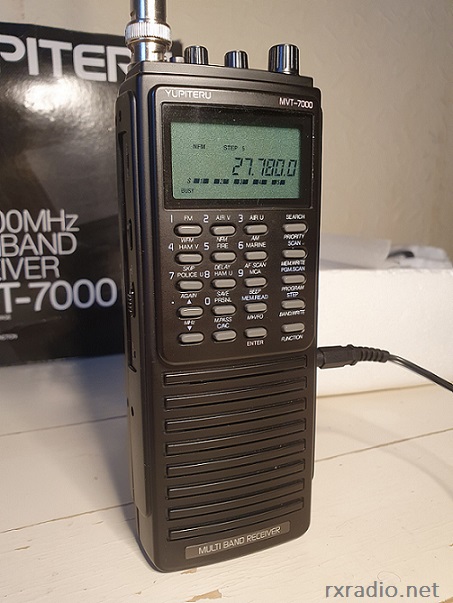
Such as, the battery compartment side plastics start to crack due to the pressure of the batteries pushing against the plastic. And after a while the cracking, unless treated / fixed, which requires considerable, competent DIY work to be fixed correctly if there’s almost a complete failure, will result in the complete breaking of the side plastics. This may leave the lower end of the unit broken and the radio may then be unable to be used with batteries. The poor design is disappointing. With mine I always have it plugged into the mains for fear of cracking the side plastics from using batteries. When batteries have been used in the unit they are a very tight fit, adding to the concern of cracking the lower sides.
Needless to say its always been used on a mains adaptor. This makes the MVT-7000 more annoying to use as it somewhat removes the “portable” aspect out of why I bought the radio.
Then there’s the battery capacitor failure that is common in both of these models. This results in losing all saved channels from the memory and radio settings, as well as other sporadic issues that can make the radio act erratic that are related to the capacitor failing which have been reported. Many people do replace the battery capacitor when it fails, but this does require opening up the unit and doing a small amount of soldering. Some users are fine with this, but the majority will not feel confident opening up the radio and replacing a part that requires soldering.
So it ends up on eBay for sale or sitting in a drawer for a few years. There’s always the option of sending the radio in for repair. There are people in the USA, Canada and UK who repair this very problem for a small fee. And due to how widespread this issue is, they are well versed in performing this easy replacement and have done it many times.
Sadly, even my MVT-7000, which has hardly been used throughout its life has potentially got some form of this memory backup capacitor failure. But mine only seems to happen when using the mains adapter.
If the mains adapter is plugged on at the mains and plugged straight into the radios power jack, the saved memories almost always “clear” and they’re all gone. But if the adapter is plugged into the side of the radio, and the power is set to off at the mains initially and then turned on, it doesn’t seem to happen. This is another known issue related to the mains adaptor power / memory battery capacitor.
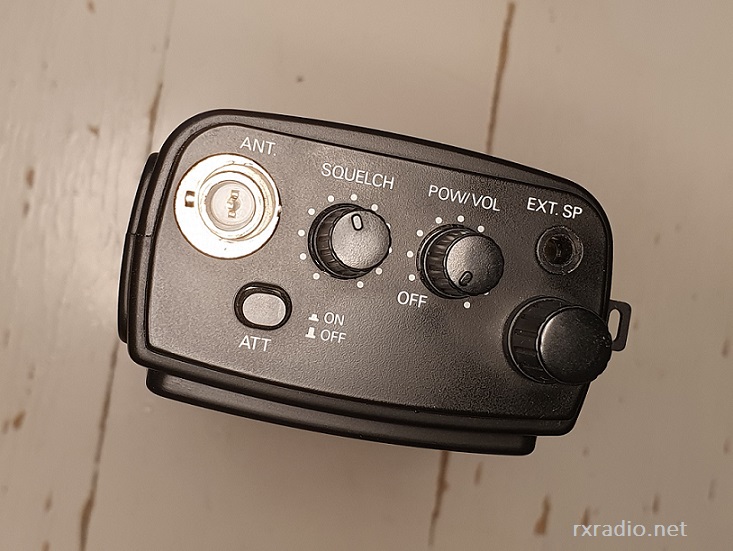
Also, the antenna connection at the top has been known to have poor soldering and can break, which will need re-soldering internally. Even on my own 7000 there is a slight bit of play / movement on the antenna port, which is supposedly normal. But doesn’t fill me with confidence that it won’t snap internally over time and need to be repaired. Especially when some antennas I use are fairly heavy or stiff to twist on to the radio.
Reception / Signal Vs Quansheng K6
On top of that the MVT-7000 is so sensitive its ridiculous. It’s way too sensitive and will stop at just about anything. A lot of the time at ghost signals and interference from other devices that other radios seem to ignore. So it can be a little frustrating to use at times.
I have compared the 7000 with my modified Quansheng K6. I have come to conclusion that while the MVT-7000 is a good radio and very easy to use, the Quansheng K6 is the better radio overall. It’s much more convenient to use, has no devastating underlying common issues, and is much more well behaved when it comes to picking up signals. In terms of signal comparison strength and clearness, they were pretty evenly matched. The 7000 does have a really good quality internal speaker. But so does the Quansheng in a cheaper, higher treble kind of way. Even if it is a bit tinny. But sometimes this high treble clearness can actually help hear some signals better.
So overall I would give the advantage to the Egzumer modified Quansheng.
Add to that the light up keypad and screen on the K6, which can be set to any length of time and and the fact that its very study and its a clear winner in my eyes. Yes, the K6 has 30 years of advanced technology at its fingertips, so this could be looked at as a bit of an unfair comparison. I don’t think so, though, because the 7000 is still considered as one of the great handhelds, regardless of its age. And the Quansheng models are some of the cheapest transceiver “scanners” coming out of China that work really well. Comparing and testing the two side by side was interesting. Not many people, including myself, expect a cheap radio from China to be able to beat or even compete with such a golden oldie. But it can.
Reliability
Reliability is very high on my list, and this is one of the biggest let downs about the Yupiteru. There’s potential for a lot of important, essential features to go wrong. And from what I’ve seen and experienced, the problems mentioned are widespread, and they don’t just affect a certain radio manufacturing year or stock batch. It’s luck of the draw, with high odds of getting a radio that will suffer from one of the mentioned issues at some point. With the Battery capacitor failure issue, I believe the capacitor does have a limited lifespan. So, putting nostalgia aside, I would choose the Quansheng. Modified of course.
Comparing the build quality of the MVT-7000 to another classic model of the same era, the Realistic Pro 43, and the difference is quite obvious. However, the Yupiteru 7000 does perform better than some of the other radios I’ve tested from the same era, most notably the AOR 8000. Which in my opinion is a terrible radio. It’s miles better than the AOR 8000. Not in housing build quality or amount of modes available, but in every other area.