There’s not many reviews available for the 10 Watt KSUN HF123D Transceiver. But from what is available online pretty much reveals that its a decent enough radio. But I wouldn’t recommend it as there seems to be too many issues and complaints from users. It’s one of the many do-it-all radios coming out of China. They all mostly have the same features, very similar frequency ranges and talking [yes, it talks] stock software installed. The annoying thing about these radios is their product descriptions never seem to be 100% accurate. So look at it more like a somewhat accurate description and specification of the radio. Leaning more on the side of accurate.
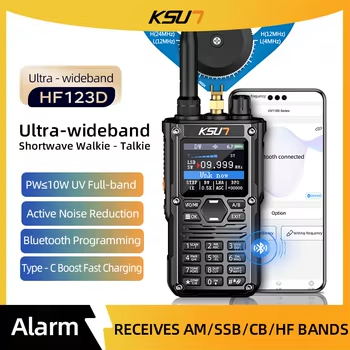

Frequency range on the KSUN HF123D is 0.152 – 1000MHz with some gaps. There are two antenna connections at the top of the radio. Covering Shortwave, MW, HF, / VHF / UHF [HAM, CB [FM transmit only], Airband, NOAA] etc. With many modes, including AM, FM, SSB, LSB, USB and CW. It also has 960 channels, Bluetooth programming, noise reduction feature, VOX, DTMF, USB Type-C charging and a built-in spectrum analyzer.
Of course, the screen is colour, and the front casing shell is made from metal. An alloy as KSUN calls it. Although some users say it feels like quite a cheap, poor quality plastic radio overall. Battery is said to be between 3500mAh and 4000mAh. Although one buyer / reviewer claimed to have tested the batteries capacity and it was only 1550mAh.
This is considered a 10 Watt radio. But as we know, almost all of these cheaper radios coming out of China do fall a bit under the power levels to what is stated. Some are quite bad, but some are actually really good. However, I have seen a few tests for this radio and the highest power level was around 7.5 Watts. So not that bad really. But do be aware that the quality control of this radio seems to be lacking, so I would not trust this measurement to be accurate across all radios produced.
The KSUN HF123D is very similar to models from other brands, such as Bajeton, Iradio and Radtel. All have similar models with a few differences in frequency range, build quality, channel amounts, battery life, transmit power etc. Be aware of the lack of programming software, instructions and overall support available for the HF123D radio. Personally I would steer clear of the KSUN HF123D. There are much better options out there for sale from the brands mentioned above for a similar price.